Windhedge
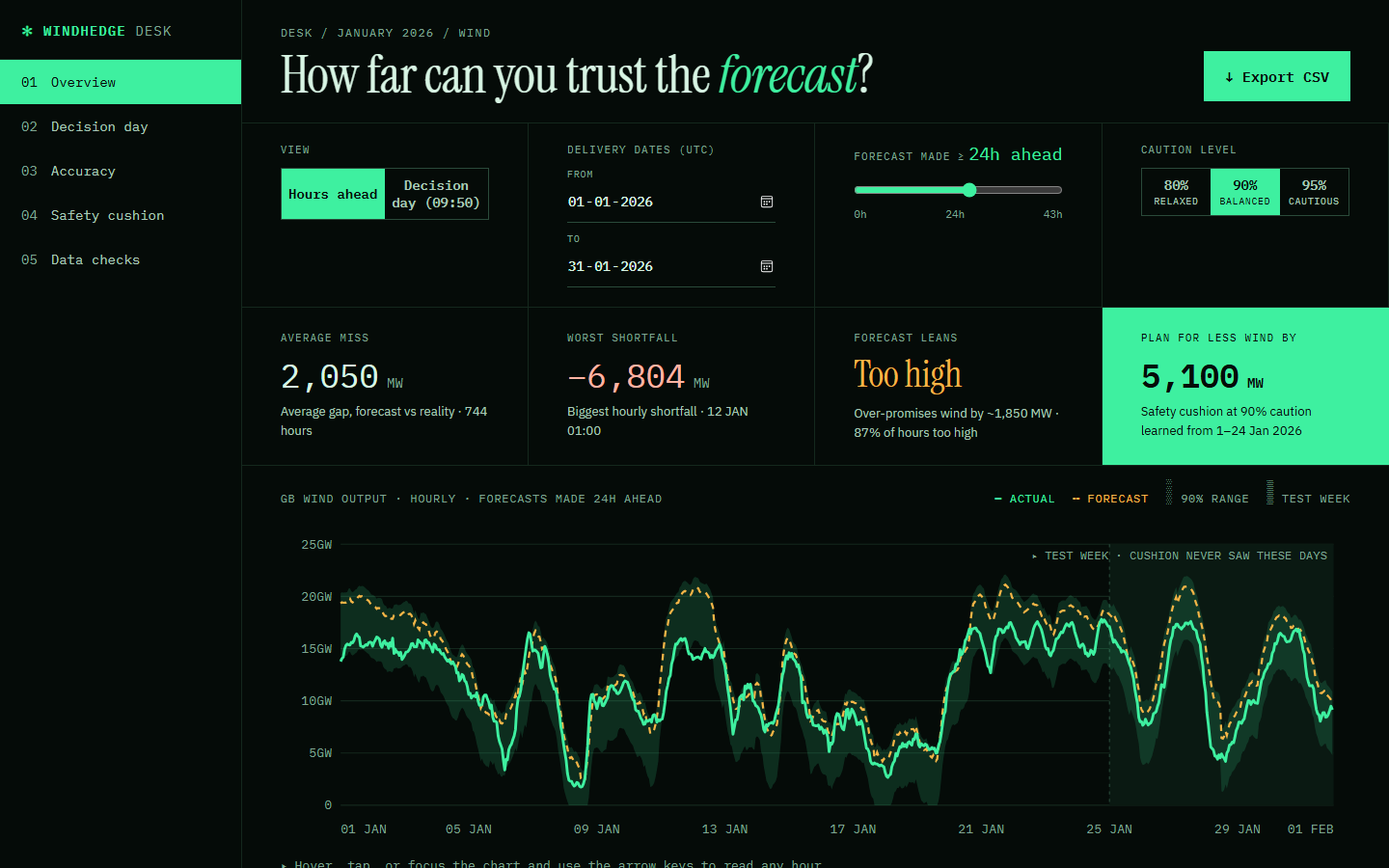
Shows the UK wind forecast that was really available when each day-ahead order was due, and how much safety margin to plan for.
Don’t guess the gust, buy what you must.
A UK energy company buys electricity on the day-ahead market, so orders for tomorrow go in today. Wind is a big and changeable part of supply, so the buyer needs to know what the forecast said at the moment the order was due, not what a later, better forecast says.
Windhedge uses public Elexon data to show exactly that, measures how wrong those forecasts were in January 2026, and works out a safety margin to plan for. It doesn’t build a prediction model of its own: it displays and evaluates the forecasts that already exist.
Elexon WINDFOR forecasts against actual FUELHH output, January 2026. Rough figures from one month, so treat them as indicative.
From public data to a margin.
FUELHH actuals + WINDFOR forecasts
Parquet, committed with the repo
matching rule, metrics, cushion
controls, chart, readouts
how much wind to plan for
one command locally, live on the web
What it does.
Forecast as the buyer saw it
Picks the newest forecast published before the 09:50 UTC day-ahead deadline, never a later, better one that didn’t exist yet.
Honest accuracy numbers
Measures miss, lean and wobble across all 744 hours of January 2026, by hours ahead, wind level and time of day.
A safety cushion
Says how much wind to plan as missing, at 80%, 90% or 95% caution, learned from past forecast errors.
Back-tested on unseen days
The cushion is learned from 1–24 January and tested on 25–31 January. The per-wind-level version failed, and the desk labels it that way.
An interactive desk
Sliders for hours ahead and caution level, a date range, a forecast-vs-actual chart and CSV export.
Containerised and tested
FastAPI and React run together with docker compose up, with pytest, Vitest, linting and CI on every push.